The Age of Criminal Responsibility: A Closer Look at Doli Incapax
By Naisha Shekhar
Published
Topic
Legal Concepts
See
Disclaimer: Views expressed herein are solely those of the author and do not necessarily reflect the views of other writers or the Law Student Review

The Australian legal system has been guided by three pillars, for as long as democracy has led and served the nation itself. Namely - they include the executive, the judiciary, and the legislature. Three specific bodies that fulfill differing roles, yet it is their intertwining that allows the nation to pass any form of legislative action, have a clear platform to exercise and apply it, and most of all - introduce legal reform in an utilitarian manner. Any form of legal reform that is introduced and integrated into the existing legal system can only continue to exist for as long as society’s ethical, moral, and social views align in its favour. A prominent and rather relevant example to understand this closely, is the longstanding debate regarding the age of criminal responsibility.
I GENERAL OVERVIEW
As of today, across Australia, the age of criminal responsibility for a youth is 10 years old, which means that any child aged 10 or older can be found guilty or arrested for an offence under Crimes Act 1914 (Cth). Children between the ages of 10-14 are afforded the common law presumption of “doli incapax” which states that the child is incapable of committing a crime due to the lack of understanding of the difference between right and wrong.[1] However, this presumption can be rebutted by the prosecution proving the mens rea (intention) behind the act with sufficient evidence, leaving children in this 10-14 category susceptible to incarceration. To put things into perspective, the recommended international standard under customary law is 14 as the baseline - as outlined in the Convention On The Rights of A Child (CROC). [2]
II BENEFITS AND IMPLICATIONS
Some members of society have associated certain benefits with this current model - arguing that not raising the age upholds personal responsibility and doesn’t excuse bad behaviour. Others believe that it enforces accountability from a younger age, and serves as a stringent incentive for children to remain compliant with the law by understanding the gravity of the consequences if they choose otherwise. And yet, critics on a domestic level [3] and around 31 member states of the UN have widely condemned Australia’s lack of reform as evidence suggests that it induces greater harm to children, encourages recidivism and positions Australia as an outlier player on the global stage. To further understand the implications of this law on Australian youth, we must look into the varying ways in which it can impact them - in both a non-legal and legal manner. Firstly, contemporary scientific research according to the Australian Medical Association (2020) indicates that children under 14 lack the developmental capacity to form criminal intent or comprehend the gravitas of their actions.[4] Furthermore, studies conducted by the Australian Institute of Mental Health and Welfare in 2023 [5]prove that the earlier youth get involved with the criminal justice system, the more likely they are to have long-term or repeated involvement in crime.
This is because criminal records and labelling tend to inculcate a harmful, irreversible “criminogenic” identity in children, which hinders them from rehabilitation in society as they are less likely to complete their education and find employment. Finally, the current punitive bail system in states like Victoria and NSW, children aged 10-13 are detained on remand, even when they are unlikely to receive a custodial sentence for the offence. These serve as possible justifications for why 94% of children imprisoned between the ages of 10-12 receive at least one more prison sentence before they reach adulthood.[6] Evidently, the implications of the current laws surrounding the minimum age of criminal responsibility outweigh the benefits for Australian youth.
III FURTHER IMPACTS ON INDIGENOUS YOUTH
However, further disparities caused by this current statute are evident when we look at the treatment of Indigenous Australian youth, who despite making up just 6% of the Australian population aged 10-17 continue to be disproportionately incarcerated at 17 times the rate of non-Indigenous children. [7] They are less likely than non-Aboriginal children to receive a caution from police and more likely to be charged with a criminal offence. As a result, empirical evidence suggests that the age of criminal responsibility being set so low creates a cycle of reoffending and imprisonment amongst the Indigenous youth community - causing further disadvantages such as less viable employment opportunities, disrupted education, deteriorating holistic health etc.
“If you target them from a younger age, by fining Indigenous kids who are already in a crisis, they are less likely to be able to pay them off, leading to more warrants, causing a cycle of stress and unjustness for them and their communities”
- Tristan Tipps-Webster, CEO of Reconciliation NSW [8]
IV REFORM TAKEN AND POTENTIAL ALTERNATIVES
In response to these concerns, several domestic jurisdictions have undertaken legislative reform. The Northern Territory government raised the age to 12 in August 2023 after data showed it had the highest form of overrepresentation of Indigenous youth in its jails. Victoria then raised the age of criminal responsibility from 10 to 12, following the enactment of The Youth Justice Act 2024, accelerating the proposed reform by legislating it two years prior to the expected date (2027). [9]Similarly, ACT implemented a two-staged approach - first raising the age to 12 in November 2023 and later to 14 in July 2025. [10] However, NSW remains one of the only states in Australia that thus far has not made any progress towards raising the age of criminal responsibility.
“The facts are well-established. What we do now does not work. The NSW Government must show the political will to build a better way - with us. Services, communities and workers are coming together in NSW to support raising the age because we know the issues, understand the problems and can build the alternatives” - Emily Mayo, Campaign Coordinator, Raise The Age NSW [11]
This is despite 48 organisations including Amnesty International publicly releasing submissions that showcased the importance of raising the age and the dangers of early entry into the criminal system - with 96% highlighting the overrepresentation of Indigenous children as a major concern in their push to raise the age. [12]
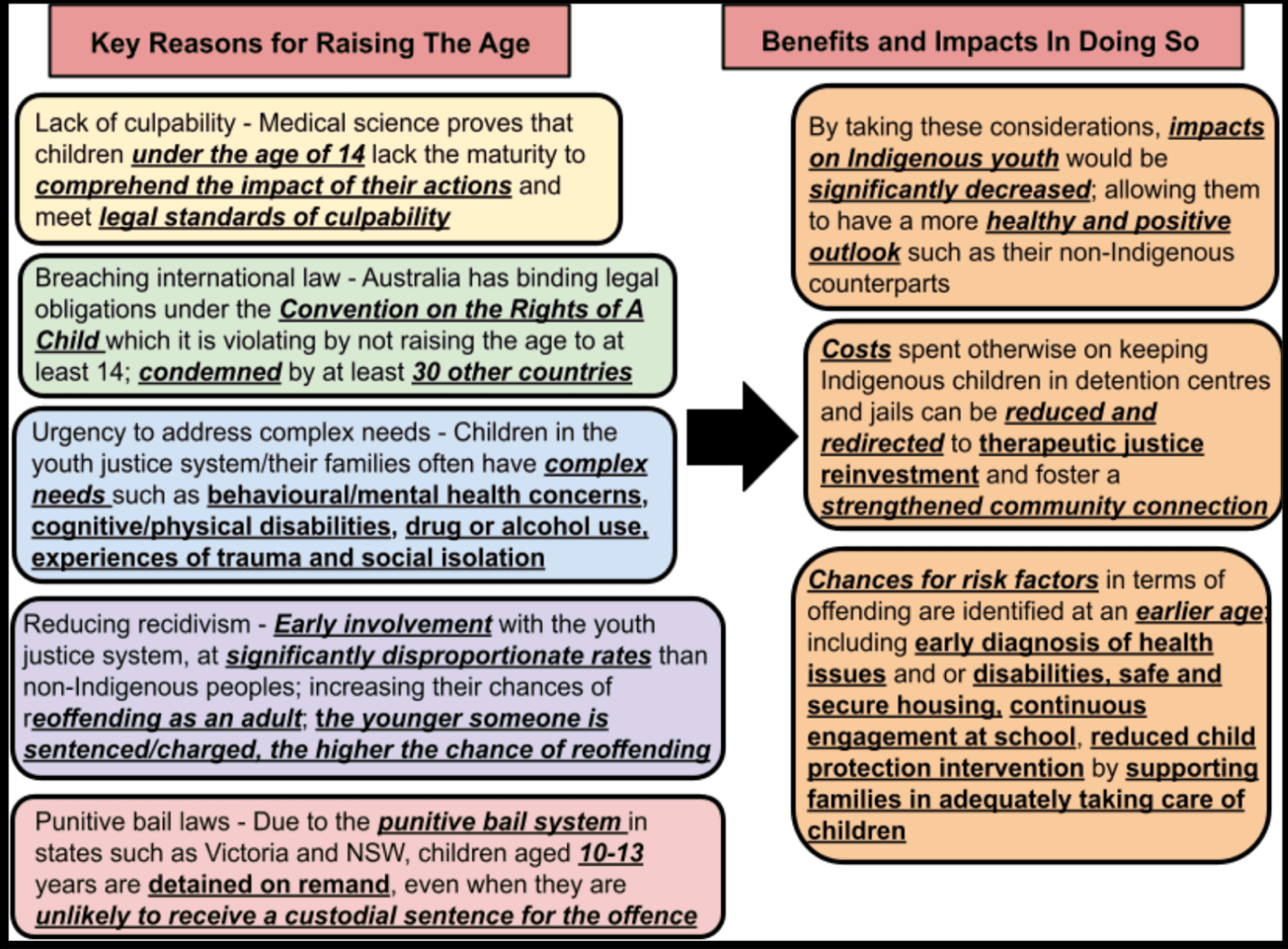
(Flowchart depicting the positive consequences of raising the age of criminal responsibility in Australia to at least 14 and minimum age for detention to 16) [13]
Therefore, in order for the nation to witness a decrease in incarceration rates amongst youth, reform regarding raising the age of criminal responsibility must be prioritised on a national scale. Until then, diversionary programs and justice-reinvestment oriented associations such as Tribal Warrior Association (Redfern NSW), must be further invested in to be able to deter the exploitation of children’s susceptibility to incarceration. They focus on rehabilitation and reintegration to prevent children from having lifelong interactions with the law, by addressing the root causes of such behaviour and finding a way to strike a balance between the government’s stringent approaches and youth’s noncompliance with the law.
In conclusion, the age of criminal responsibility continues to remain a prominent legal concern for the nation, ultimately calling upon policy and changemakers to reconsider the current legislation surrounding it and introduce wide-scale reform.
V FOOTNOTES
[1] Australian Institute of Health and Welfare, ‘Youth detention population in Australia 2023’, 2023, https://www.aihw.gov.au/reports/youth-justice/youth-detention-population-in-australia-2023/contents/understanding-youth-detention-in-australia/raising-the-age-of-criminal-responsibility.
[2] (No date) Raising the age of criminal responsibility. Available at: https://create.org.au/wp-content/uploads/2022/12/PPR-Raising-the-Age-of-Criminal-Responsibility-221122.pdf (Accessed: 19 February 2026).
[3] Catie McLeod and Tamsin Rose, ‘Renewed push for NSW to raise age of criminal responsibility to 14’, The Guardian, 25 October 2023, https://www.theguardian.com/australia-news/2023/oct/25/renewed-push-for-nsw-to-raise-age-of-criminal-responsibility-to-14,[25 October 2023].
[4] Design, A.B. (2022) Health and medical experts call for the age of criminal responsibility to be raised to at least 14, Raise The Age. Available at: https://raisetheage.org.au/news-stories/open-letter (Accessed: 18 February 2026).
[5] Australian Institute of Health and Welfare (n 1).
[6] Explainer: Why we need to raise the minimum age of criminal responsibility (2022) Amnesty International Australia. Available at: https://www.amnesty.org.au/why-we-need-to-raise-the-minimum-age-of-criminal-responsibility.
[7] AIHW (2024) Youth detention population in Australia 2024, Aihw.gov.au. Available at: https://www.aihw.gov.au/reports/youth-justice/youth-detention-population-in-australia-2024/contents/summary/first-nations-young-people-in-detention.
[8] Tristan Tipps-Webster, Interview, 3 April 2024.
[9] Australian Institute of Health and Welfare (n 5).
[10] Ibid.
[11] Public Interest Advocacy Centre, ‘Leading Organisations come together to #RaiseTheAge in NSW’, 25 October 2023, https://piac.asn.au/2023/10/25/leading-organisations-come-together-to-raisetheage-in-nsw/#:~:text=Raising%20the%20 minimum%20age%20of[5 April 2024].
[12] Dozens of submissions made public after attorney-generals refuse to act on raising the age of criminal responsibility in Australia (2022) Amnesty International Australia. Available at: https://www.amnesty.org.au/dozens-of-submissions-made-public-after-ags-refuse-to-act-on-raising-the-age-of-criminal-responsibility (Accessed: 19 February 2026).
[13] Victorian Aboriginal Legal Service, ‘Raising the Age of Criminal Responsibility (Policy Brief)’, Victoria, 2022, https://www.vals.org.au/wp-content/uploads/2022/08/Raising-the-Age-of-Criminal-Responsibility-Policy-Brief-August-2022.pdf [4 April 2024].