Bed Bath 'N' Table v Global Retail Brands [2025]
By Katie Tooma
Published
Topic
Case Summaries
See
Disclaimer: Views expressed herein are solely those of the author and do not necessarily reflect the views of other writers or the Law Student Review
I FACTS OF THE CASE
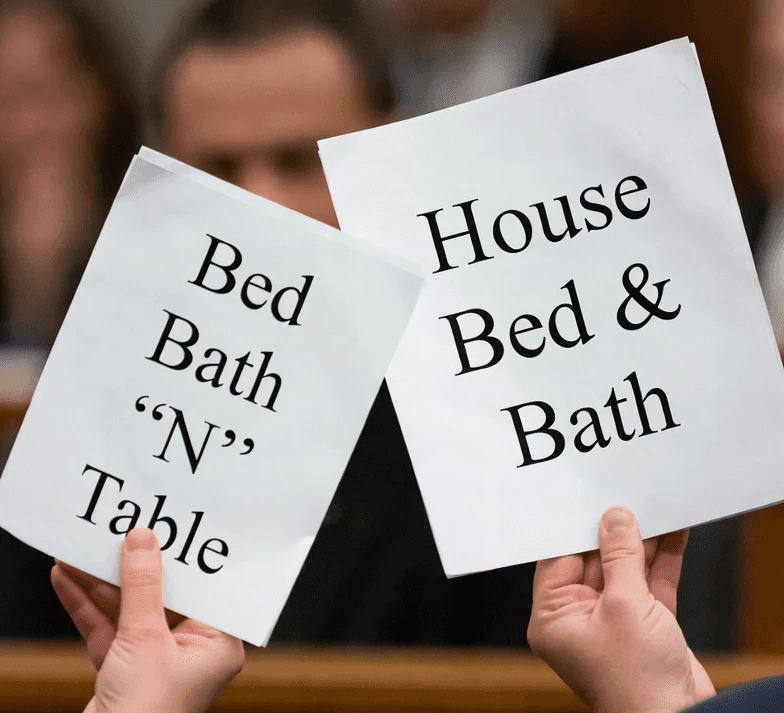
On 14 May, 2021, Global Retail Brands Australia Pty Ltd (GRBA) used ‘House Bed & Bath’ (the ‘House B&B mark’) as the name of its new soft homewares store in Westfield Doncaster shopping centre. This included the use of the House B&B mark on the external signage over the store entrance, internal signage, the House website, store receipts, social media, shopping centre directories and advertising and promotional materials, gift cards and employee name badges. This decision followed an email suggestion from Meghan McGann, GRBA’s Head of Brand and Media, on 3 May 2021 to Mr Lew, the founder, director and executive chairman of GRBA, wherein McGann recommended the House B&B name and brand on the basis that it “[w]ill have Bed Bath ‘N’ Table running scared” (the “running scared email”).
‘BED BATH ‘N’ TABLE’ (BBNT), who have traded under this mark since 1976, brought proceedings against GRBA in the Federal Court of Australia. BBNT alleged that by using the House B&B mark, GRBA had contravened both s120 of the Trade Marks Act 1995 (Cth) and s18(1) of Australian Consumer Law (the ACL).
II THE PRIMARY JUDGE’S DECISION IN THE FEDERAL COURT (13 MARCH 2024)
The primary judge in the Federal Court of Australia (Rofe J) found that GRBA’s use of the House B&B mark infringed upon s18(1) of the ACL, however, did not infringe on the BBNT trade marks as provided by s120 of the Trade Marks Act 1995 (Cth).
To assess s120 of the Trade Marks Act 1995 (Cth), the court asks whether an ordinary consumer with an imperfect recollection of the registered trade mark would be caused to wonder whether the two marks were the same or associated. When applying this test, her Honour found that several “substantial and crucial differences between the marks” meant that an ordinary consumer would not be caused to wonder whether the marks were the same or associated. Her Honour therefore found that the House B&B mark was not “substantially identical with, or deceptively similar to” the BBNT mark. Thus, Her Honour concluded that GRBA’s use of the House B&B mark did not contravene s120 of the Trade Marks Act 1995 (Cth).
On the other hand, a breach of s18(1) of the ACL, is determined based on the court assessing GRBA’s conduct, the immediate and broader market context and the impact of the businesses conduct on the consumer’s mindset. The “running scared email” provided direct evidence that GRBA was aware of BBNT’s longstanding market presence in the soft homewares market at the time it adopted the House B&B branding. This led her Honour to draw an inference that GRBA appreciated the likelihood that consumers would associate BBNT with House B&B. This was characterised by her Honour as a form of wilful blindness, apt to mislead consumers. When holistically examining the conduct of GRBA, her Honour found GRBA, for the first time, both adopted a “Hamptons” style presentation akin to BBNT’s stores, and prominently displayed the House B&B mark and branding on their Doncaster store. Her Honour furthered the assessment in considering the broader market context, specifically BBNT’s extensive reputation over 40 years in the Australian soft homewares market and the fact that no other Australian retailer had ever used “bed” and “bath” together and in that order on external signage. The primary judge’s assessment led her to conclude that it was very likely that consumers were enticed into GRBA’s soft homewares store in the belief that they had some association with BBNT. Her Honour therefore drew the conclusion that GRBA’s conduct was misleading or deceptive or likely to mislead or deceive in contravention of s18(1) of the ACL.
III THE FULL FEDERAL COURT OF AUSTRALIA’S DECISION (31 OCTOBER 2024)
On appeal, the Full Federal Court (Nicholas, Katzmann and Downes JJ) overturned the primary Judge’s finding that GRBA’s use of the House B&B mark contravened s18(1) of the ACL. For the Full Court, GRBA’s use of the House B&B mark infringed on neither s18(1) of the ACL nor s120 of the Trade Marks Act 1995. The Full Federal Court reasoned that, given the primary judge’s “clear finding” that BBNT’s reputation was in the BBNT mark as a whole and BBNT did not establish “that it has any independent reputation in ‘BED BATH’ or ‘BED & BATH’ alone”, the use of the House B&B mark would not evoke BBNT in the mind of the ordinary and reasonable consumer, and therefore s 18(1) had not been contravened by the GRBA’s use of the House B&B mark. In reaching this conclusion, the Full Federal Court dismissed the primary judge’s finding that GRBA was aware of the risk of consumer confusion and deliberately proceeded with the House B&B branding, treating this wilful blindness as incapable of assisting the assessment of misleading or deceptive conduct.
IV LEGAL ISSUES
The issue raised was whether the absence of trademark infringement under s120 of the Trade Marks Act 1995 precludes a finding of misleading or deceptive conduct under s18(1) of the ACL.
V THE HIGH COURT’S DECISION (10 DECEMBER 2025)
On appeal, the High Court (Gageler CJ, Gordon, Edelman, Jagot and Beech-Jones JJ) unanimously reinstated the primary judge’s finding of a contravention of s18(1) of the ACL, and not s120 of the Trade Marks Act 1995.
This conclusion arose from the Court’s finding that the Full Court misunderstood the primary judge’s reasoning for finding a breach of s18(1) of the ACL and not s120 of the Trade Marks Act 1995. On appeal, it was held that the Full Federal Court misapplied s18(1) by failing to assess the impugned conduct in its immediate and broader market context, including GRBA’s wilful blindness and BBNT’s extensive reputation, as required by the statutory inquiry into whether conduct is likely to mislead or deceive the ordinary and reasonable consumer. When those factors were properly considered, the High Court held that GRBA’s conduct was misleading or deceptive within the meaning of s18(1) of the ACL.
VI IMPLICATIONS OF THE DECISION
The decision confirms that liability under s 18(1) of the Australian Consumer Law is not determined by the presence or absence of trade mark infringement. Instead, liability depends on an assessment of the business’ conduct as a whole including whether, in light of the immediate and broader market context, reasonable steps were taken by the business to avoid conveying a misleading or deceptive impression to the ordinary and reasonable consumer.